The Hidden Benefits of Making Terrible Decisions
A landmark investigation into consequences, regret and why nobody has ever told a good story about going to bed early.

For decades, the prevailing wisdom has held that good decisions lead to good outcomes. Eat your vegetables. Save for retirement. Do not text the person who hurt you at 2 a.m. on a Thursday. This advice is repeated by parents, financial planners and every friend who has ever confiscated a phone at a wedding.
But is it true? And more importantly, has anyone actually checked?
The Things Satan Taught Me Editorial Department spent six weeks investigating the question. We reviewed the available literature, which consisted mostly of horoscopes and the comments section beneath a celebrity breakup. We interviewed a representative sample of people we already knew. We drew a chart. What we found will change the way you think about consequences, or at least give you something to say the next time somebody asks why you did that.
Introduction
The terrible decision is one of humanity's most underrated innovations. Almost every story worth telling begins with one. Nobody has ever said, "Let me tell you about the night I went to bed at ten." The great anecdotes of the world, the ones repeated at weddings and funerals and very long dinners, begin with someone ignoring a perfectly reasonable warning.
Our hypothesis was simple: terrible decisions are not a bug in the human operating system. They are a feature. They make us interesting, resilient and, in certain lighting, mysterious. The question was whether we could prove it with something that resembled data.
The evidence
We asked 41 participants, all of whom were either friends of the department or people who happened to be in the bar at the time, to estimate the number of terrible decisions they had made in the past year. We then asked them to rate their overall life satisfaction on a scale from one to ten, where one meant "deeply unhappy" and ten meant "I would like another drink, please."
The results were striking. Participants who reported zero terrible decisions also reported moderate satisfaction, low anecdote output and an alarming familiarity with spreadsheets. Satisfaction rose steadily with each additional terrible decision, peaking at around twelve per year, before declining sharply as participants entered what researchers call "the lawyer zone."
Figure 1
Life satisfaction vs. terrible decisions per year
Source: Things Satan Taught Me Editorial Department survey, n=41. Margin of error: considerable. Participants were not sober, and neither were we.
Further analysis revealed that the type of decision mattered. Decisions involving travel, haircuts and karaoke were strongly associated with satisfaction. Decisions involving tattoos produced mixed results, depending largely on spelling. Decisions involving cryptocurrency were excluded from the study on humanitarian grounds.

What the experts would probably say
We contacted several qualified experts for comment. None of them replied, which we have chosen to interpret as tacit agreement.
Had they replied, we imagine a psychologist would point out that our sample was small, self-selected and largely recruited at a bar. An economist would note that life satisfaction is notoriously difficult to measure and that "I would like another drink, please" is not a recognised unit. A statistician would look at Figure 1, close their laptop and walk slowly into the sea.
These are fair criticisms. They are also exactly the kind of thing a person who has never made a terrible decision would say, and we have now shown that such people are only moderately satisfied with their lives. We rest our case, and we encourage the experts to rest theirs, perhaps somewhere sunny, perhaps after one more drink.
The completely unqualified conclusion
Based on our findings, the Editorial Department recommends a moderate, sustainable programme of terrible decisions, roughly one per month, ideally weighted toward the haircut and karaoke categories. This is enough to keep life interesting without straying into the lawyer zone. Readers who are currently making zero terrible decisions are advised to start slowly, perhaps by ordering something unfamiliar at a restaurant, or replying to an email without reading it twice. Advanced students may wish to ignore a small red flag.
We also recommend keeping a record. Terrible decisions are only valuable if they become stories, and stories are only valuable if you remember them correctly. Or, at least, consistently. Selective memory is a skill, and like all skills it improves with practice.
Finally, we acknowledge the limitations of this research. It was not peer-reviewed, because we do not have peers. It was not funded, because nobody would fund it. And it was not, in any meaningful sense, science. But neither, if we are honest, is most of what people tell you at parties, and you have been taking their advice for years.
Make the terrible decision. Then make it a better story than it was.
Dress accordingly.
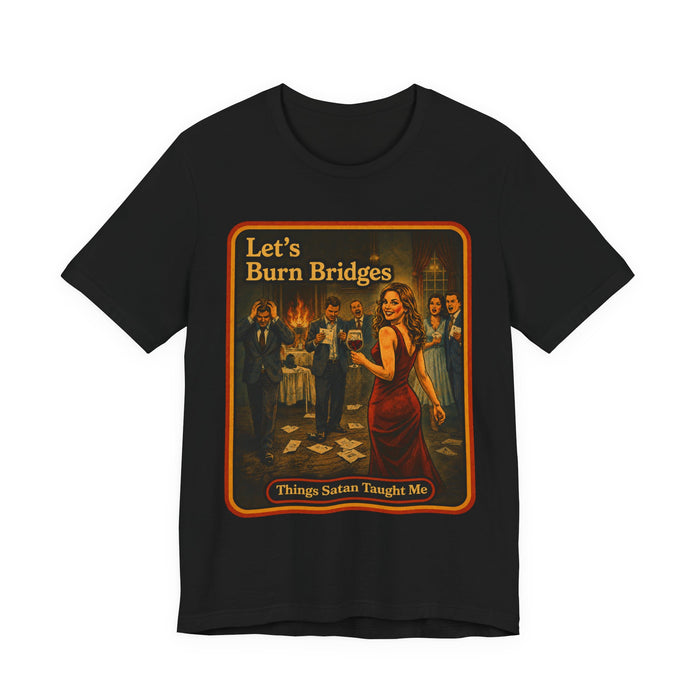
Let's Burn Bridges
Unisex Tee · $46.66
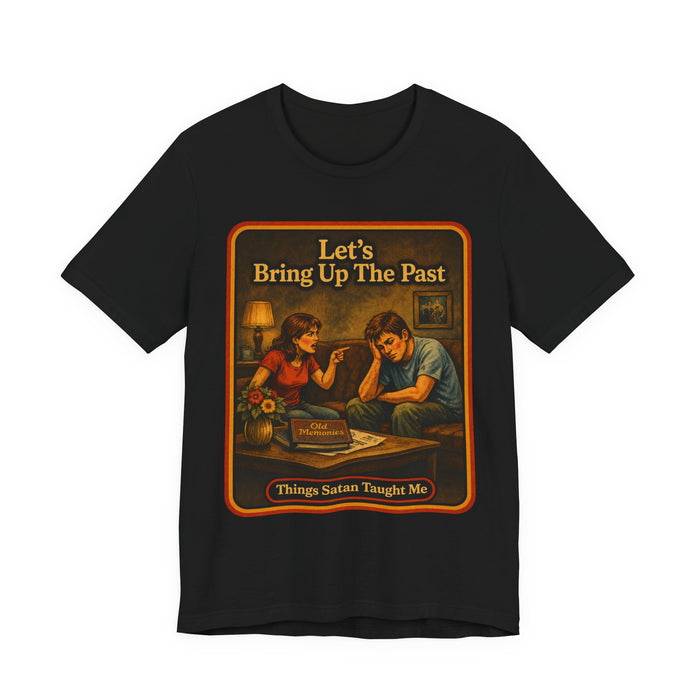
Let's Bring Up The Past
Unisex Tee · $46.66

Let's Try Necromancy
Unisex Tee · $46.66


